
Rising Drug Production in an Increasingly Unstable Golden Crescent
Updated: Sep 15
Poppy cultivation continues to expand across Afghanistan, Pakistan and Iran despite reports of the imminent demise of natural opiates
Since the Taliban announced its poppy ban in Afghanistan in April 2022, there has been considerable speculation about the demise of natural opiates and their inevitable replacement by synthetic opioids. While UNODC has correctly reported the dramatic fall in cultivation following enforcement of the ban in late 2022, it has erroneously estimated that Afghanistan’s remaining opium stocks will be depleted by the end of 2026 and that cultivation in neighbouring countries remains marginal.
Instead, natural-opiate production in the Golden Crescent is not declining but in fact resurging in 2026 as opium poppy cultivation expands across Afghanistan, as well as in neighbouring Pakistan and Iran. Within Afghanistan, cultivation has risen notably in the increasingly restive northeastern province of Badakhshan, and in the southwest where substantial opium stocks had insulated many landed farmers from the economic effects of the Taliban’s drugs ban. While larger landowners in southwestern provinces like Helmand still retain significant stocks and therefore the capital to withstand the ban, growing numbers of smaller landowners faced depleted inventories and economic ruin that compelled them to resume cultivation this year and resist eradication efforts. The tensions were such that in May 2026 the Taliban leadership issued instructions preventing local authorities from entering household compounds to destroy poppy or seize opium without a court order. This has raised the prospect of increased production in subsequent seasons.
The increase in poppy cultivation in Pakistan’s Balochistan province has been dramatic, where growing numbers of Afghan farmers from the southwest have leased land and established expanding areas of monocropped poppy. In 2025, more than 9,000 hectares of poppy were cultivated in Balochistan - enough to produce the opium required to meet the heroin demand of consumers in the United Kingdom - making the substantial rise in cultivation this year even more consequential. In 2026, similar patterns of land tenure and poppy cultivation also emerged in Iran’s Sistan-Balochistan province, where many farmers are using drip irrigation to increase opium yields. Meanwhile, a summer poppy crop in Balochistan is extending the growing season and adding further to regional opium supplies.
Consequently, prices for opium and its derivatives continue to fall, reaching levels in parts of Afghanistan not seen since the spring of 2023, when the enforcement of the Taliban st poppy ban was first realised. Taken together, expanding cultivation, substantial remaining stocks, improved opium-to-heroin conversion rates and an increasingly sophisticated market for adulterated opiates, provide no evidence that supplies to Europe’s premium heroin markets will run dry any time soon. On the contrary, amid political instability, economic decline, permeable borders and rising violence, drug production in the Golden Crescent is adapting and relocating, much as it did after the outbreak of Afghanistan’s first civil war in the 1990s. This time, however, its centre of gravity appears to be shifting towards the tri-border region, with Pakistan’s Balochistan province at its core.
In addition to exploring the impact of the Taliban’s drug ban on the 2025-26 poppy season within Afghanistan, this article also explains how growing instability in the region, fuelled by the border conflict between Pakistan and Afghanistan, the United States and Israel’s war with Iran, and an increasing active insurgency in Balochistan, is creating the ideal conditions for widespread drug production and further violence across the Golden Crescent.
It Ain’t Over Till It’s Really Over: Substantial Opium Production Continues in Afghanistan
Afghanistan has seen dramatic reductions in poppy cultivation since the Taliban takeover in August 2021 and their announcement of a drug ban the following year. Despite this, the country remains an important player in the global market for natural illicit opiates. Evidence points to rising cultivation in 2026 in what are two of the country’s most important opium growing provinces: Badakhshan and Helmand. There are also substantial stockpiles remaining in the southwest, especially among large, landed farmers in provinces like Helmand. Farmers from southwestern Afghanistan are also important players in the emergence of widespread poppy cultivation in Balochistan province in Pakistan, and increasingly in neighbouring Sistan Balochistan in Iran. The result has been a further decline in opium prices, that could undermine the Taliban’s ability to maintain the poppy ban in the future (see Figure 1).


Badakhshan: A rise shaped by multiple common shocks and the absence of viable alternatives
Following the Taliban’s effective enforcement of the poppy ban across much of Afghanistan in 2023, cultivation became increasingly concentrated in the northeastern province of Badakhshan, where farmers largely ignored the prohibition and continued to grow the crop widely. Consequently, Badakhshan’s share of Afghanistan’s total poppy area rose from less than 3% before the ban was enforced to as much as 50% in 2024, despite only marginal increases in cultivation within the province (see Figures 2).


In 2026, satellite imagery shows substantial increases in cultivation across much of Badakhshan compared to 2025. This expansion was unsurprising: after the 2025 harvest, farmers throughout the province had made clear that they intended to plant even larger areas with poppy the following year. Central to that decision was drought, sharply reducing yields across crops, including poppy, and leaving most farmers considerably worse off than in 2024.
The drought’s agricultural and economic effects were intensified by the shift in cropping patterns caused by the Taliban’s efforts to suppress poppy cultivation in the province. Embarrassed by the repeated defiance of the Taliban leader Mullah Haibatullah’s religious edict, the provincial authorities mounted a campaign in late 2024 to deter planting. The campaign was led by Juma Khan Fateh, a powerful Badakhshi Taliban commander who has increasingly come into conflict with the movement’s leadership over the distribution of proceeds from the province’s gold mines and his increasingly fragile position within the administration.
At the time, Juma Khan displaced poppy cultivation from lower-lying, higher-yielding surface-irrigated land into more remote, drought-prone rainfed fields (see Figures 3 and 4). When the spring rains failed in 2025, these areas were particularly hard hit: yields fell to the equivalent of less than nine kilograms per hectare (from 28 kilograms in 2024), and many farmers lost their crop entirely (see Figure 5). Consequently, although many Badakhshi farmers planted more poppy on rainfed land than they had forgone in irrigated areas, their incomes fell dramatically (see Figure 6).


The losses were so severe that the Taliban halted eradication in many districts in the spring and summer of 2025, recognising that there was little crop left to destroy and that what remained offered some economic respite to a rural population already heavily affected by drought. These pressures intensified in July 2025, when Tehran expelled undocumented Afghan migrants, disrupting remittance flows that had long served as an important coping strategy for the population of Badakhshan.
With even relatively wealthy farmers in the province unable to meet their basic needs without recourse to opium production, only minimal stocks, and high levels of debt to service, an expansion poppy planting in 2026 was inevitable (see Figure 7). In the planting season in late 2025 farmers once again prioritised rainfed land, planting ever larger areas with poppy (see Figures 8 and 9). However, imagery also shows significant cultivation in irrigated areas, suggesting that farmers were willing to risk the threat of eradication. Unlike in 2025, however, the crop performed well in both places. Farmers not only planted much more land in 2026 but also achieved yields of up to 38 kilograms per hectare on rainfed land and 55 kilograms per hectare in irrigated areas.


Although official accounts portrayed the eradication campaign as robust - reporting that as many as 1,000 soldiers had been deployed across the province for a month to target an estimated 12,500 hectares of poppy - imagery indicates a far more localised effort, largely confined to readily accessible irrigated and rainfed areas (see Figure 10). Local observers argue that the sheer scale of cultivation in Badakhshan in 2026 made an effective province-wide campaign impossible without substantial additional resources and show of power. Indeed, controlled experiments in the UK[1] and previous experience in other provinces of Afghanistan support this claim, and suggest that a force of 8,000 soldiers would have been required to eradicate 12,000 hectares of poppy with sticks over a 30-day period.
Such an effort would have required deploying significant numbers of Taliban security forces from other provinces - an approach that has previously triggered widespread violence and unrest in Badakhshan. Amid growing instability in the province, including the escalating conflict with Juma Khan, and a notable upswing in violent resistance from opposition groups, the Taliban leadership appears to have been intent on avoiding that outcome, particularly as opposition to eradication also intensifies in southwestern Afghanistan.
Instead, the authorities have sought to deter the opium trade in Badakhshan, mounting a growing number of checkpoints that have reduced the seasonal influx of “Helmandi” traders – a generic term for southern Pashtoons – that has further depressed prices after what has been a particularly good harvest. With farmers in Badakhshan now preparing their rainfed land for planting poppy in the fall there continues to be little to deter even further cultivation in 2027, particularly as the political environment in the province becomes even more unstable.

Helmand: Growing economic disparities and falling prices threatens the Taliban’s ability to maintain the poppy ban in their political heartlands
Helmand has recorded historically low levels of poppy cultivation since the Taliban enforced the ban in the 2022/23 growing season. Traditionally Afghanistan’s principal poppy-growing province, accounting for as much as half of the country’s annual cultivated area, Helmand saw cultivation fall from 129,640 hectares in 2022 to just 740 hectares in 2023 and 750 hectares in 2024. Cultivation rose modestly to 1,270 hectares in 2025, as farmers in more remote areas - particularly the marginal northern districts - resumed production on a limited scale. In 2026, cultivation almost doubled to 2,320 hectares: some farmers who had planted poppy the previous year expanded the area devoted to the crop, while others, encouraged by the success of their neighbours, also returned to cultivation (see Figure 11).

Although poppy cultivation in Helmand remains only a fraction of its pre-ban level, mounting economic and political pressures have prompted the authorities to soften their stance on the ban. The factors driving the increase in Helmand are more complex than those in Badakhshan.
Helmand and much of the southwest exhibit far greater socio-economic differentiation than many other parts of Afghanistan, largely because of wide disparities in landholdings. With few employment opportunities and no assets to sell, including opium stocks, landless households working as sharecroppers - who typically received only one-third of the final crop - were immediately affected by the Taliban’s poppy ban. By contrast, landowners benefited from the dramatic rise in opium prices that followed the ban because they retained stocks accumulated during years of overproduction (see Figures 12 and 13). These stocks have been critical both in insulating farmers in the southwest from the ban’s economic effects and in shielding the Taliban from a political backlash in its heartlands.


With depleting stocks and insufficient land, small landowning farmers increasingly face economic ruin
Pressure to resume poppy cultivation has become acute among smaller landowning farmers in southwestern Afghanistan. Detailed livelihood analysis shows that without poppy and relying on current alternatives, a landowner in Helmand with less than three hectares of surface-irrigated land, or four hectares of former desert land, cannot earn enough from farming to reach the international poverty line of US$3.00 per person per day. For an average household of ten, this is equivalent to US$10,950 per year (see Figures 14).

With few opportunities to earn non-farm income - particularly in the province’s remote northern districts, where landholdings in surface-irrigated areas are considerably smaller - many small landowners have had to sell opium stored before the ban simply to meet their households’ basic annual food needs. Less frequent but more costly expenses have required further sales, reducing their remaining stocks. These expenses include medical treatment in Kabul or Pakistan for serious health conditions; life-cycle events such as marriages and funerals; purchases of transport, including cars and motorbikes; and essential agricultural investments, such as installing or repairing solar-powered irrigation systems.
Because they had smaller landholdings - and consequently less land on which to grow poppy during the peak years of cultivation - these farmers were also less likely to have accumulated large residual opium stocks before the Taliban enforced the ban (see Figure 15). In the first year after the ban, opium prices rose sharply, peaking at US$1,000 per kilogram in December 2023. They subsequently declined as the market adjusted to growing evidence of substantial stocks within Afghanistan, continued cultivation in the northeast, and the rapid expansion of opium production first in neighbouring Pakistan and then also in Iran. By July 2026, prices in the southwest had fallen below US$400 per kilogram, despite four consecutive years of historically low cultivation. This downward trend has compelled smaller landowners to sell increasing quantities of opium each year to make ends meet.
For example, economic analysis shows that, at an opium price of US$1,000 per kilogram, a farmer cultivating one hectare of surface-irrigated land along with winter wheat and summer okra and tomatoes would need to sell around 10 kilograms of opium to cover household food requirements and the additional high-cost expenses incurred that year. This quantity is equivalent to the yield from almost one-seventh of a hectare of poppy. As prices fell from their December 2023 peak, the same farmer had to sell progressively more opium to compensate for insufficient farm income. Ten kilograms covered the shortfall in December 2023, but the required amount rose to almost 17 kilograms in December 2024 and 22.5 kilograms one year later. If prices remain at around US$400 per kilogram, the farmer will need to sell a further 25 kilograms to meet household living expenses in 2026 (see Figure 16).
Over four years, therefore, a farmer with one hectare of land would have had to sell the equivalent output of 1.1 hectares of opium poppy cultivation - more opium than the farmer could have produced in 2022, the last successful harvest before the ban was enforced. Farmers with other sources of income, including trade, wage labour, or earnings from a family member cultivating opium in neighbouring Pakistan or Iran, may not have depleted their stocks entirely. Even so, those left with only a few kilograms are becoming increasingly concerned about their future as opium prices continue to decline. Although these small farmers initially supported the ban becuase it drove prices higher and they expected further increases, they have become increasingly hostile to the Taliban’s efforts to maintain it.


Large landowners remain resilient drawing on their substantial opium stocks
The position of larger landowners is different, especially in the former desert areas where more than half of the province’s poppy crop - and 25% of the country’s annual cultivated area - was located between 2019 and 2022. Satellite imagery analysis indicates an average farm size of 4.9 hectares in these areas (see Figure 17). Although this land is often less productive than surface-irrigated areas, farmers can meet their families’ food requirements without poppy and still generate some surplus cash for consumer goods. Imagery further shows that, before the ban, many farmers cultivated as much as half of their land with opium poppy, enabling them to accumulate substantial stocks.

In these areas, an overwhelming majority of landowners extol the benefits of the Taliban’s poppy ban and the inflated opium prices it produced in previous years. They speak of having enough opium stored to last “ten years”, “twenty years”, or even “a lifetime”. Estimates based on available economic data and geospatial analysis indicate that the 48,500 farmers across 237,000 hectares of former desert land in the southwest could have accumulated as much as 13,717 metric tonnes of opium - equivalent to 283 kilograms per household - during the four years preceding the ban, from 2019 to 2022. This estimate excludes stocks retained by landowners in the southwest’s surface-irrigated areas and by traders.
Because current cropping systems provide enough food for their families, landowners in the former desert areas need to finance only their more costly annual expenses through the sale of opium stocks. At declining prices, this would have required the sale of a total of 30 kilograms of opium over the four years of the ban, still leaving each household with an average of 253 kilograms and an estimated aggregate stock of 12,270 metric tonnes in these former desert areas alone. Unlike farmers with small landholdings, therefore, those in the former desert areas are not being driven back towards poppy by destitution. Rather, the pressure comes from some of the sharecroppers working their land and from fears that further price declines will force a more rapid liquidation of stocks.
Rising tensions and cultivation prompt Taliban concessions that weaken the ban
Together, these economic pressures contributed to the near doubling of opium poppy cultivation in Helmand in 2026, much of it in the northern districts. During the final months of the 2025 planting season, it was already evident that more farmers intended to expand cultivation in 2026. Poppy cultivation had increased between 2024 and 2025, with growing evidence of crops concealed within household compound walls. Rumours that the authorities in Musa Qala had turned a blind eye to cultivation that year also fuelled demands from farmers in other districts to be allowed to resume cultivation during the following season.
High-resolution satellite imagery shows the extent of the increase in 2026, with more poppy fields concealed behind household compound walls and within wheat fields in northern districts such as Musa Qala and Kajaki (see Figures 18, 19 and 20). Much larger, unconcealed fields - absent in 2025 - are also visible in these areas, suggesting that farmers were willing to risk crop destruction. Although local authorities made some effort to curb cultivation in these and other parts of Helmand, they faced growing dissent and, at times, violent resistance. Concern about unrest in Helmand and elsewhere in the southwest became so acute that by mid-May, the Ministry for the Prevention of Vice and Promotion of Virtue reportedly issued instructions to the courts via WhatsApp - allegedly on Haibatullah’s orders - prohibiting local authorities from entering household compounds to search for poppy cultivation or opium without a court order.

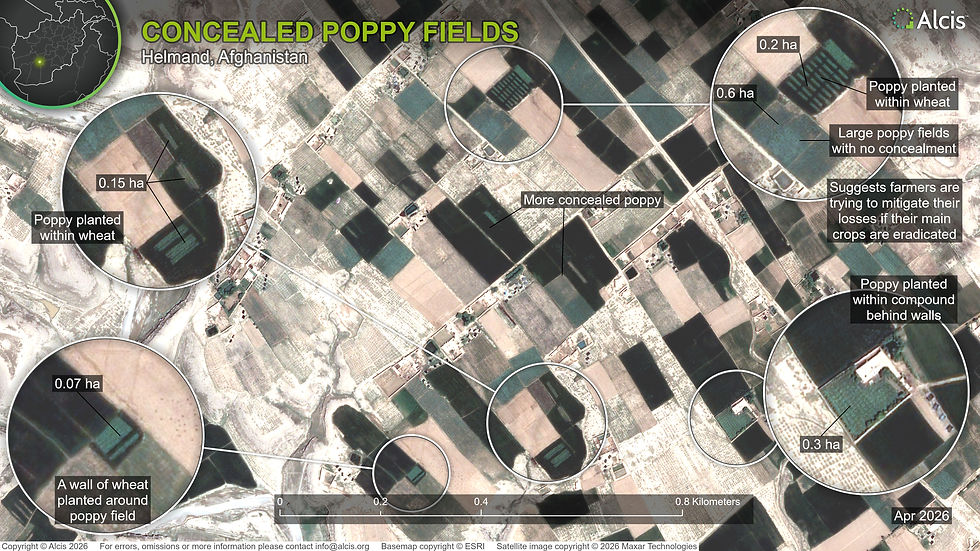

Farmers across the southwest have welcomed this concession. Although it does not formally rescind the poppy ban - which would be difficult given the religious authority underpinning Haibatullah’s original edict - it represents a compromise that farmers believe permits cultivation within the boundaries of their household compounds. This is significant: it responds to a deepening rural economic crisis affecting a growing number of landowners in the southwest, while offering a political accommodation to a rural constituency that has long been among the Taliban movement’s most ardent supporters and an important source of fighters. In the context of the Taliban’s continuing poppy ban, the effects of this concession remain unclear. Future cultivation may remain largely contained within existing household compounds. However, because some larger compounds enclose more than two hectares of agricultural land, the ruling also raises the prospect of a substantial increase in production next year.
There is also a risk that some farmers in the southwest - particularly those with rapidly diminishing stocks - will interpret the concession as a signal that the authorities will tolerate more widespread cultivation beyond the confines of walled compounds. Imagery already shows the number and size of unconcealed poppy fields expanded in parts of Helmand in 2026. The authorities could deal relatively easily with a small number of farmers who felt emboldened by the ruling and destroy their crops. A large-scale return to cultivation, however, would present a much greater challenge, requiring a more aggressive eradication campaign that could provoke violence. The Taliban will seek to avoid such an outcome, particularly in its own heartlands. Yet as more landowners in the southwest deplete their stocks, face few viable alternatives, and confront a worsening economic crisis, the risk of mounting rural dissent - even in the southwest - is real.
Pakistan and Iran: Poppy’s Ever-Expanding Footprint Amongst Afghanistan’s Neighbours
The expansion of opium poppy cultivation in Pakistan’s Balochistan province, and more recently in Iran’s Sistan and Baluchestan province, has eased some of the economic pressure on farmers from Uruzgan, Helmand, Kandahar and Farah in southwestern Afghanistan, who have been unable to produce opium at home because of the Taliban’s poppy ban. Drawing on family ties and contacts in Pakistan and Iran - some established while living there as migrants and refugees - these farmers have crossed the border to cultivate poppy as tenants and sharecroppers. Other Afghans have joined them as wage labourers during peak periods of the agricultural season, particularly weeding and harvesting.
The crop is now becoming increasingly entrenched across the tri-border region. Typically cultivated on unusually large farms, often as a monocrop, the area under poppy is expanding rapidly as more farmers seek relief from Afghanistan’s worsening economic conditions. Cultivation has also spread markedly into Iran’s Sistan and Baluchestan province, where farmers are using drip irrigation to increase yields. Landowners in both Balochistan and neighbouring Sistan and Baluchestan, have been keen to learn and welcomed these Afghan farmers and their knowledge of opium production and trade. Consequently, even if poppy cultivation resumes more widely in Afghanistan and many Afghan farmers return to their farms in the southwest, there is a heightened risk that large-scale opium production across the tri-border region will persist.
Balochistan: “the New Afghanistan”
Although UNODC suggests that reports of increased cultivation in Pakistan are anecdotal and that any rise is marginal, satellite imagery, videos, photographs, and field reporting indicate otherwise (see Figures 21, 22 and 23). In 2025, satellite imagery identified 9,116 hectares of poppy cultivation in Balochistan alone. Imagery also showed rising cultivation in Khyber Pakhtunkhwa between 2023 and 2024, while further increases were reported there in 2025 and in parts of Sindh, although on a much smaller scale than in Balochistan.


Cultivation in Balochistan has been rising since 2023, driven largely by Afghan farmers from the southwest who relocated to the province to escape restrictions imposed under the Taliban’s drugs ban. Compared with the mountainous areas of Khyber Pakhtunkhwa to the north, where poppy was traditionally grown, Balochistan offers significant agricultural and economic advantages. Landholdings in Khyber Pakhtunkhwa are particularly small, soils are thin, and the scope for substantial expansion is therefore more limited.
By contrast, much of Balochistan’s poppy is cultivated in large fields on former desert land irrigated by solar-powered deep wells. The same technology supported the settlement of almost 237,000 hectares of desert land in southwestern Afghanistan between 2003 and 2024 - an area that accounted for one-quarter of the country’s annual poppy cultivation between 2019 and 2022. The socio-economic processes underpinning the spread of cultivation in Balochistan are also similar: much of the labour required by this labour-intensive crop is supplied by land-poor households employed as tenants, sharecroppers, and wage labourers.
As the Taliban’s poppy ban persisted in southwestern Afghanistan, growing numbers of farmers returned from Balochistan each season with accounts of successful harvests and proceeds from opium sales, encouraging further expansion of the crop. Imagery shows a significant increase in the area devoted to poppy in 2026, even compared with the already extensive crop in 2025 (see Figures 24 and 25). Many farms exceed five hectares, and poppy fields are typically much larger than those found in Afghanistan even during the peak years of cultivation. Evidence of monocropping is also increasing as Afghan farmers specialise across the border: they devote the land they cultivate in Balochistan to poppy while using their farms in southwestern Afghanistan to produce food crops (see Figures 25 and 26).
Opium yields in Balochistan have also been favourable in 2026. Imagery shows fields that are lusher than in 2025, while farmers report yields of 45–50 kilograms per hectare. At a harvest-time price of US$280 per kilogram in Killa Abdullah - almost US$200 per kilogram below the contemporaneous price in southwestern Afghanistan - gross returns could reach US$14,000 per hectare. Many Afghan farmers lease as much as five hectares and share both costs and output equally with Baloch landowners, giving them potential annual net earnings of up to US$21,000. Even sharecroppers, who often work smaller farms of up to 2.5 hectares and receive up to one-fifth of the crop while bearing no associated input costs, could have earned the equivalent of US$2,800 per hectare. The crop was so extensive in 2026 that workers travelling from Afghanistan for the harvest could command as much as US$14 per day, in addition to food and accommodation.
Nor is poppy cultivation in Balochistan confined to the winter season: there is ample evidence of an extensive summer crop in both 2025 and 2026 (see Figure 27). There is also little to fear from eradication by the Pakistani authorities who find themselves increasingly under attack from insurgent groups, especially the Balochistan Liberation Army. Consequently, while official assessments continue to characterise reports of poppy cultivation in Balochistan as inconsequential, farmers in southwestern Afghanistan know otherwise and are likely to continue to travel there in ever greater numbers to produce opium.


The beginnings of widespread cultivation in Iran
There are signs that similar patterns of migration and opium production are emerging in neighbouring Iran. In 2025, poppy cultivation was reported along Iran’s eastern border with Afghanistan, in Razavi Khorasan and Sistan and Baluchestan provinces; along its western border with Iraq, in Kermanshah and Lorestan; and in the southern province of Fars. Reports from many of these areas indicated that farmers from southwestern Afghanistan were involved, working as tenants and sharecroppers much as they do in neighbouring Pakistan.
In 2026, satellite imagery shows extensive poppy cultivation in parts of Sistan and Baluchestan. The fields are large, and poppy is often grown as a monocrop, as in Balochistan province of Pakistan (see Figures 28 and 39). Some farmers also appear to use drip irrigation for poppy cultivation. Because installing these systems requires substantial investments at the start of the season, their use suggests that farmers anticipated little risk of eradication when they planted in late 2025 (see Figures 30). Subsequent reports from Afghan farmers still in Sistan and Baluchestan, as well as from those who have returned to their homes in southwestern Afghanistan, indicate opium yields of 35–45 kilograms per hectare and a harvest price of US$250 per kilogram.
Most of these farmers described their experience in 2026 in very positive terms. Those who live in Iran throughout the year combine poppy cultivation with other activities, including construction work, livestock production, and the cultivation of licit crops. For example, a farmer from Nimroz who had travelled intermittently to Iran for many years in search of agricultural work reported cultivating poppy for the first time in 2026. Working as a sharecropper and receiving one-third of the final yield, he earned US$3,800 from growing opium on 1.6 hectares of land in Sistan and Baluchestan. Following this success, he exclaimed: “Now there is poppy, I will go to Iran every year.”
As in Pakistan’s Balochistan, Afghan labourers also appeared in the area during the weeding and harvesting seasons. Attracted by wages equivalent to US$6.45 per day and contracts lasting 20 days, these workers came from southwestern Afghan provinces such as Helmand and Uruzgan. Many more Afghans arrived during the harvest and were paid between one-eighth and one-seventh of the final opium yield. Furthermore, preoccupied by the outbreak of war with the United States and Israel, the Iranian authorities did not move to destroy the poppy crop in 2026, further increasing the confidence of opium producers in the area. With hostilities continuing, the authorities facing more pressing priorities, and the economy in steep decline, further increases in poppy cultivation in Iran should be expected in 2027.


Conclusion: Rising Drug Supplies are Fuelling Regional Instability
There is no shortage of opium in Afghanistan. Large farmers and traders report retaining substantial stocks accumulated before the Taliban imposed its poppy ban and dismiss suggestions that these supplies will be exhausted by the end of the year. More than 12,000 metric tonnes of opium are estimated to remain in the country, while domestic production between 2023 and 2025 added a further 2,100 metric tonnes to the supply chain. The pipeline has since been reinforced by increased Afghan production in 2026 and dramatic growth in poppy cultivation in Pakistan and Iran over the past two years. A summer poppy crop in Balochistan further sustains the flow of opiates within the region and to downstream consumers.
The opiates market has also adapted to the poppy ban, helping to preserve supplies for premium European markets. Adulteration of opium and its derivatives have long been common in Afghanistan, but became ubiquitous as prices rose after the ban, particularly in regional markets where consumers have less purchasing power. Cooked opium, known locally as chaynak, is often adulterated by as much as 40%; cross-border traders report that consumers favour the cheaper mixture and its effects. The market for opium derivatives - including morphine base, heroin base, and heroin hydrochloride - is similarly segmented, with cheaper, more heavily adulterated products sold within the region. Some made-to-order products leaving Afghan heroin laboratories currently contain only 40% heroin base. By directing these lower-purity derivatives to lower-priced regional markets, the trade conserves higher-purity supplies for consumers in Europe.
Improved opium-to-heroin conversion rates upstream in Afghanistan have also helped sustain heroin supplies to Europe despite the Taliban’s drug ban. Cooks increasingly specialise in a single product - morphine base, heroin base, or heroin hydrochloride - thereby improving extraction efficiency and fostering an internal market for derivatives. They are also more selective about their inputs, particularly opium, water, and chemicals, sourcing higher-quality materials to maximise yields. Repeated extraction cycles minimise waste, a critical adaptation given the high cost of opium since the ban. Morphine producers have become particularly adept, with some using activated charcoal, hydrochloric acid, and acetone to improve product quality and purity.
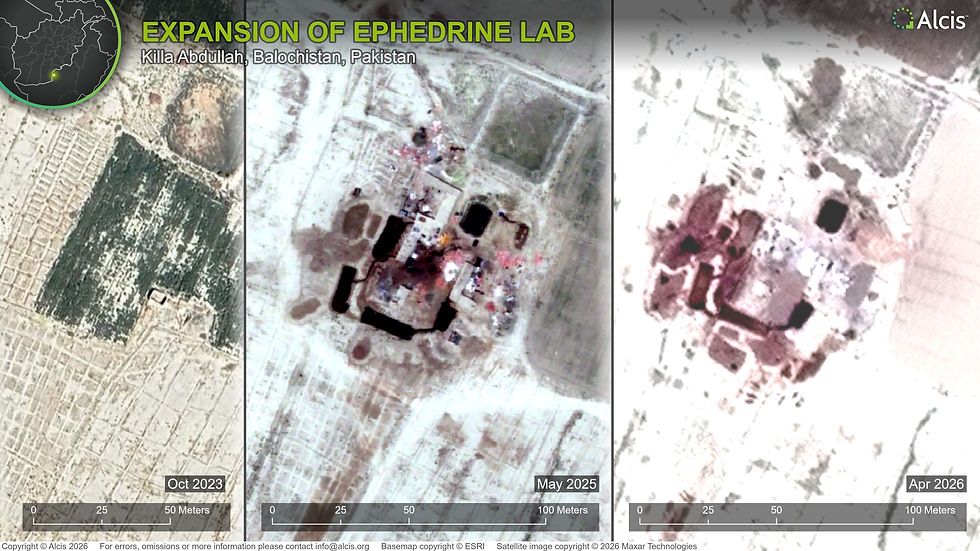
These skills are now being transferred to Pakistan, where reports point to a growing number of laboratories in Balochistan drawing on Afghan expertise. This knowledge transfer is also evident in ephedra-based methamphetamine production and in the increasing number and scale of laboratories identified in the province in 2026 (see Figures 31 and 32). Ephedrine laboratories have proliferated in Balochistan since the Taliban curtailed production in Afghanistan in September 2022, while reports of methamphetamine production are increasing in both Balochistan and Iran’s Sistan and Baluchestan province. The rise in methamphetamine production in Pakistan is particularly notable in light of reports that 1.5 metric tonnes of methamphetamine were recently seized in Germany. The role of Afghan labour in expanding drug production in both countries, together with the continued movement of Afghan migrants through Pakistan en route to Iran, contrasts with official accounts of border closures and mass forced returns.

This expansion of drug production across the tri-border region is unfolding in an increasingly unstable political environment, marked by rising violence and competition among armed groups seeking revenue from cross-border value chains. Baloch farmers and their Afghan tenants, for example, report paying Pakistani law-enforcement officials to avoid eradication. Pakistani officials, the Iranian dissident group Jundullah, and an Iranian Revolutionary Guard Corps (IGRC)-backed “security group” also extract payments from migrants and people smugglers travelling through Balochistan from Afghanistan to Iran. Pakistani law enforcement has established numerous checkpoints that have reshaped routes used to smuggle millions of litres of Iranian fuel into Pakistan each day. In many cases, these are the same routes used to move opiates and methamphetamine (in both crystal and liquid form).
These checkpoints are increasingly becoming focal points for violence as insurgent groups such as the Balochistan Liberation Army seek to disrupt rivals’ revenue streams and control key nodes along important trade routes. The Balochistan Liberation Army’s recent spate of attacks on government checkpoints along routes used for fuel, trade, and mineral transport illustrates this tactic. Armed groups that once cooperated have also begun to compete. Since October 2025, for example, Jundullah and the IRGC-backed “security group” have reportedly engaged in protracted fighting over checkpoints on a people-smuggling route along the Pakistan-Iran border. Although it remains unclear how much these groups earn from the drug trade along the Afghanistan-Iran-Pakistan border, the dramatic expansion of production in the tri-border area risks creating stronger incentives and greater financial resources for armed competition, fuelling a self-reinforcing cycle of instability and further drug production.
Overall, the evidence points to the growing fragility of state power across the Afghanistan-Pakistan-Iran tri-border region and a heightened risk of further violence and instability. In Balochistan, the Pakistani state is increasingly marginalised by the array of armed groups operating there. The rapid expansion of poppy cultivation since 2023 - evident in the scale of the fields and the prevalence of monocropping - indicates Islamabad’s limited reach in an increasingly hostile environment. Similarly, the proliferation of drug-processing facilities, including numerous large ephedrine laboratories, suggests that federal and provincial authorities may lack either the capacity or the willingness to intervene.
The government in Tehran also appears constrained, unable or unwilling to curb the growth of informal cross-border traffic with Afghanistan and Pakistan. War with the United States and Israel has shifted government priorities, while the collapse of the rial and wider economic deterioration have made Iranian border officials more susceptible to bribery. Some may argue that informal cross-border activity is expanding at the behest of Tehran and the IRGC, as part of efforts to circumvent sanctions and generate urgently needed revenue. Yet ample evidence also suggests that autonomous border communities and commercial interests are driving much of the growth in drug production and cross-border smuggling - actors that Tehran is increasingly reluctant to alienate amid the ongoing conflict with the United States.
This pragmatism and bargaining prevail even in Afghanistan under the Taliban’s authoritarian rule. One of the Taliban’s flagship policies - the poppy ban, often presented as evidence of its absolute authority - is coming under increasing pressure from farmers impoverished by its economic effects and from a rural economy further weakened by natural disasters and border conflict with neighbouring Pakistan. At the same time, the Taliban has done little to curb heroin production, while the continued smuggling of people, drugs, and legal goods supports the expansion of opium poppy cultivation and the processing of opiates and methamphetamine in Pakistan and Iran. Taken together, these developments suggest that drug production and regional instability are becoming mutually reinforcing across the tri-border area: illicit economies weaken state control, while weak and contested governance creates the conditions in which these economies can expand rapidly in the region.
[1] The experiments conducted in the UK in 2005 measured the effectiveness of eradication efforts using different methods and at different stages of plant. They found that destroying the crop using sticks during the spring season growth when there is substantial plant matter took 20 people eight hours to eradicate one hectare of poppy. See Cranfield University, 2005, ‘Effectiveness of opium poppy eradication using selected hand, mechanised and chemical techniques, at different stages in the growing cycle’, Unpublished Summary Report for HMG, September 2005.
David Mansfield has been conducting research on illicit economies in Afghanistan and on its borders each year since 1997. David has a PhD in development studies and is the author of “A State Built on Sand: How opium undermined Afghanistan.” He has produced more than eighty research-based products on rural livelihoods and cross-border economies, many for the Afghanistan Research and Evaluation Unit, and working in close partnership with Alcis. David was also the lead researcher on the Special Inspector General for Afghanistan Reconstruction’s Counter Narcotics: Lessons from the US Experience in Afghanistan, covering the period from 2002- 2017.


People searching for the UP Bhulekh Portal can explore the official website to find available services for checking land ownership and khatauni details.
Piso WiFi can be useful when you need temporary internet access without a long-term subscription. Before starting a session, it is helpful to understand the timer, connection process, and whether pause functionality is enabled on the particular machine.
Me llamó la atención el apartado sobre Magistv APK, porque es importante conocer algunos aspectos antes de utilizar este tipo de archivo. Verificar el origen, revisar los permisos y mantener actualizado el sistema son pasos sencillos que pueden ayudar a mejorar la seguridad.
Before trying 10.0.0.1 Admin Login, it is worth checking the router’s default gateway. Not every router uses the same private IP address. Once the correct address is confirmed, connecting through Wi-Fi or Ethernet should make accessing the administration page easier.
The expressions in punjabi shayari attitude are useful for people who want to show confidence without writing lengthy captions. I liked the combination of bold and calm expressions because different readers have different personalities. Punjabi makes the words feel authentic and memorable. These lines can be shared with photographs or used as status messages. The collection provides a simple way to communicate self-belief and individuality while keeping the language creative, natural, and distinctly Punjabi.